Monday, May 3, 2010
Post 16: Spain will be just fine!

Post 15: concerns of the citizens
Post 14: Importing history
Ever since the emergence of Francisco Franco as the leader of Spain after the Civil War, Spain has made huge gains economically. After its acceptance in the European Union in the year 1986, Spain adopted the new importing system that changed procedures for importing in Spain.
Post 13: The housing decline
Sovereign risk and the so-called EMU (European Monetary System) periphery are once again taking center stage, according to economists at US investment bank Morgan Stanley who have argued that the countries generally associated with this group (Italy, Spain, Greece, Portugal and Ireland) are a very heterogeneous bunch and that some of them are no longer a ‘pure' peripheral country such as Italy.
Sunday, May 2, 2010
Spain debt rating
Spain's high unemployment rate
Friday, April 30, 2010
Tourism in Spain

This week I am going to talk about tourism in Spain, however i will try not sound like a brochure and try to keep it relative to Macroeconomics. Spain has always been a very profitable country in their tourism. The tourism boom really took off for Spain in the mid 1950's. The tourist industry has greatly increased since this time. In 1950 Spain had less then one million tourists, however over the years this number has skyrocketed to 50 million in 2003. The tourist boom had a significant, and not always completely beneficial, impact on the Spanish economy. Although this growing activity was a welcome source of foreign currency and created new employment opportunities, it also diverted capital investment and construction efforts away from more stable economic activities to a sector dutiful to seasonal fluctuations, the whims of fashion, and worldwide economic conditions.
Although this growth in tourism had some hidden negative effects on the Spanish government, nevertheless in 2003 net tourism accounted for 10% of total GDP. Spain had the highest net GDP in the world a few years ago in 2003. The United States had higher gross revenues, but its tourist expenditures exceeded revenues by a considerable margin.
Today the tourist industry in Spain has seen a decrease in numbers due to the global recession. Last summer Spain saw a 6.1% decrease in summer visitors. The country is among the top three in tourism in the world, measured by both arrivals and income earned. Since Spain has become reliant on their profitable tourist market , Spain's government approved a $1.42 billion aid plan to help the tourism sector ride the economic recession. Hopefully Spain will be able to sustain their tourism through these difficult times of recession and see an increase back to where their numbers use to be.
Sunday, April 11, 2010
Spain imports/ exports
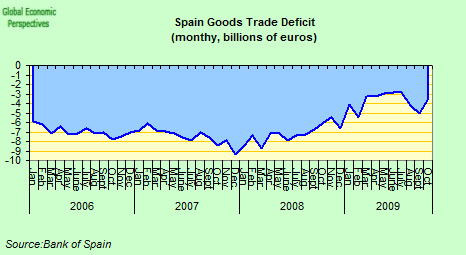
This week I am going to spend some time on Spain's imports and exports. Spain's trade is very significant to it's economy because it accounts for more then half of the countries total GDP. Spain has gone though times of high trade deficit over the past years. In 2009 Spain's trade deficit reached 77.5 billion. There are a few factors that contribute to this deficit. leading factors to this deficit are predominantly the nation’s increasing reliance on imported petrol and decreased market competitiveness. In addition, the strength of the Euro has also had an impact on the trade deficit. Since Spain has adopted the Euro, exports have steadily declined due to increased prices of exports.
Spain's major exports include motor vehicles, machinery, pharmaceuticals, foodstuffs,and medicines. The net exports for 2009 were $215.7 billion. This number was decreased by 70.2 billion from the previous year. Some major imports in Spain include mechanical and electric machinery, and iron and steel. A lack of resources in the nation, particularly oil, has created a wide spread gap between Spain's imports and exports. Spain’s imports were valued at $293.2 billion in 2009, which was a considerable decline from the 2008 level of $415.5 billion. Spain's major partners in trade for both exports and imports are from the EU region.
The spendings of Holy Week

It’s hardly penitence when it comes to the economy of Holy Week in Spain. The people of Sevilla, Spain, spare no expense when it comes to making the Easter processions of holy week the most elaborate and grand in all of Spain. This week is a major tourism week for Spain, and specifically for Sevilla. The hotels and restaurants are filled to the brim as well as the streets with tourists and locals celebrating the festivities of holy week. This year Sevilla brought in an estimated 160 million € from the processions of holy week. This amount does not even include the added value to the city in tourism promotion.
Each Brotherhood spent an average of 73,000 € to prepare their thrones for the processions. What is a Brotherhood? The Brotherhoods are associations of members of the parish who organize themselves to celebrate holy week with processions. Every Brotherhood dedicates itself to a certain scene, e.g. the burial of Christ, the taking of Christ’s body off the cross, the flogging of Christ by Roman soldiers, the judgment of Christ by Pilate, etc. As such, they also perform specific functions during the holy week. For example, the Brotherhood of Death and Resurrection of the Lord will be the one to first announce resurrection on Saturday midnight. And the three grenadier Brotherhoods dedicated to the Virgin will take to the streets on Friday of Pain – the day commemorating the Pain of the Mother. Put together in one procession, they develop the whole story of the Passion before your eyes, in a sequence of frames.
Some other major expenses of holy week include the cost of the carvings and statues, the floral decorations of the "palo", and the tunics worn by the brotherhood. The maintenance of the statues and carvings used in holy week average a spending of about 5.2 million € a year. Although many of the tunics in Sevilla are either purchased on the black market, or sewn by families, an average of 600,000 € is still declared each year from tunics. Then their is the high cost of the floral decorations mainly used to decorate the "Palo". Each brotherhood spends an average of 2,200 to 4,000 € a year on flowers used to decorate the "Palo". The processions of Holy Week are highly important to the culture of Spain as well as to their tourist industry.
Sunday, March 28, 2010
Spain contributes to the EU bailout
European and U.S. stock markets rose earlier Thursday on news that a financial rescue package for Greece was taking shape. Market worries over Europe’s weeks-long hesitation to set up a safety net for eurozone members who can’t pay their bills has sent the euro sliding to a 10-month low. The euro traded at $1.33, down from $1.51 in November.
Monday, March 15, 2010
Spain is urged to switch to Greenwich Mean Time
In March of 1940 Spain switched from Greenwich Mean time to "Berlin time" which is central European time. At the end of World War II Spain did not switch back to Greenwich time and has remained using "Berlin Time" for the past 60 years. Spain's work culture is unique because of their longer work hours with excessively long breaks. A typical worker in Spain has 30 minute coffee breaks, two hour lunch's and late evening dinners. This is very different from many other European countries were many workers eat their lunches at their desks with no breaks. Ironically, Spain is the European country were most work hours are spent however, they are among the least productive countries in Europe. The main factor against this switch is that the work pattern of Spain is claimed to be far more healthy then the nonstop working pattern of other northern European counties. It is uncertain if this switch will truly increase productivity in Spain when the workers are already so accustomed to their "siesta culture". An interesting study shows that Spain's neighbor Portugal who runs off the Greenwich Mean Time, is in fact less productive then Spain. This raises the question if Spain's time zone is truly to blame for the countries low productivity.
Friday, February 26, 2010
Post 6: VAT rates to be increased in July
Wednesday, February 17, 2010
Post 5: Spain's cost of living

Spain adopted the Euro (one Euro= 100 Euro cents) as the countries official currency in 2002. Spain uses the Euro in the following denominations:
1/2/5 cent coins which feature the Santiago de Compostela cathedral, 10/20/50 cent coins which feature the author Cervantes (Don Quijote),1 and 2 Euro coins which bare the image of King Carlos the I, and 5/10/20/50/100/200 and 500 Euro notes which do not depict any Spanish designs because the notes are the same throughout all of Europe. Since the Euro was introduced Spain has experienced a raise in the cost of living expenses because prices rounded up to the nearest Euro. Although Spain is considered one of the cheapest European Countries, many larger cities property prices are still very high in comparison with the earnings. Here are some examples to get a rough idea of some of the living costs in Spain:
Electricity: 35-40 Euro/per month per 2 people
Telephone: 25 Euro/per month plus calls
Eating out: 12 Euro/per person
Movie theater tickets: 6 Euro/per person
Friday, February 5, 2010
Can Spain keep up with the EU?
In 1986
Many experts examined
Others argue that
n 1986
Many experts examined
Others argue that
Sunday, January 31, 2010
Spain's budget deficit
Source citation: http://www.marketwatch.com/story/spain-takes-aim-at-its-soaring-budget-deficit-2010-01-29?reflink=MW_news_stmp
Sunday, January 24, 2010
Introduction of Spain's Economy
Today Spain is a largely agricultural country producing the most olive oil in the world. Spain is also the largest producer of lemons, oranges, and strawberries in all of Europe. Spain's largest industries that are mostly concentrated in Madrid consist of, textiles and apparel, foods and beverages, metals and metal products, chemicals, ships, automobiles, machine tools, clay and refractory products, footwear, pharmaceuticals, and medical equipment.
Spain conducts most of their trade from Italy, Germany, France, and Great Britain. Although the country still has a major trade imbalance, the industry has grown significantly since the 1950's. Spain's currency is the Euro, and they are a democratic constitutional monarchy with a National Parliament (Cortes Generals). Spain's head of state is King Juan Carlos I and the country has a population of 44.6 million.